
By: Aubrey Reiss Taylor
My new release, Dearest Gunter, marks the beginning of a new series, Separate Ways.
This series is jam-packed with “brave” subjects, two of which are front and center in the story of
Gunter Schrader and his childhood sweetheart, Lani Schumacher.
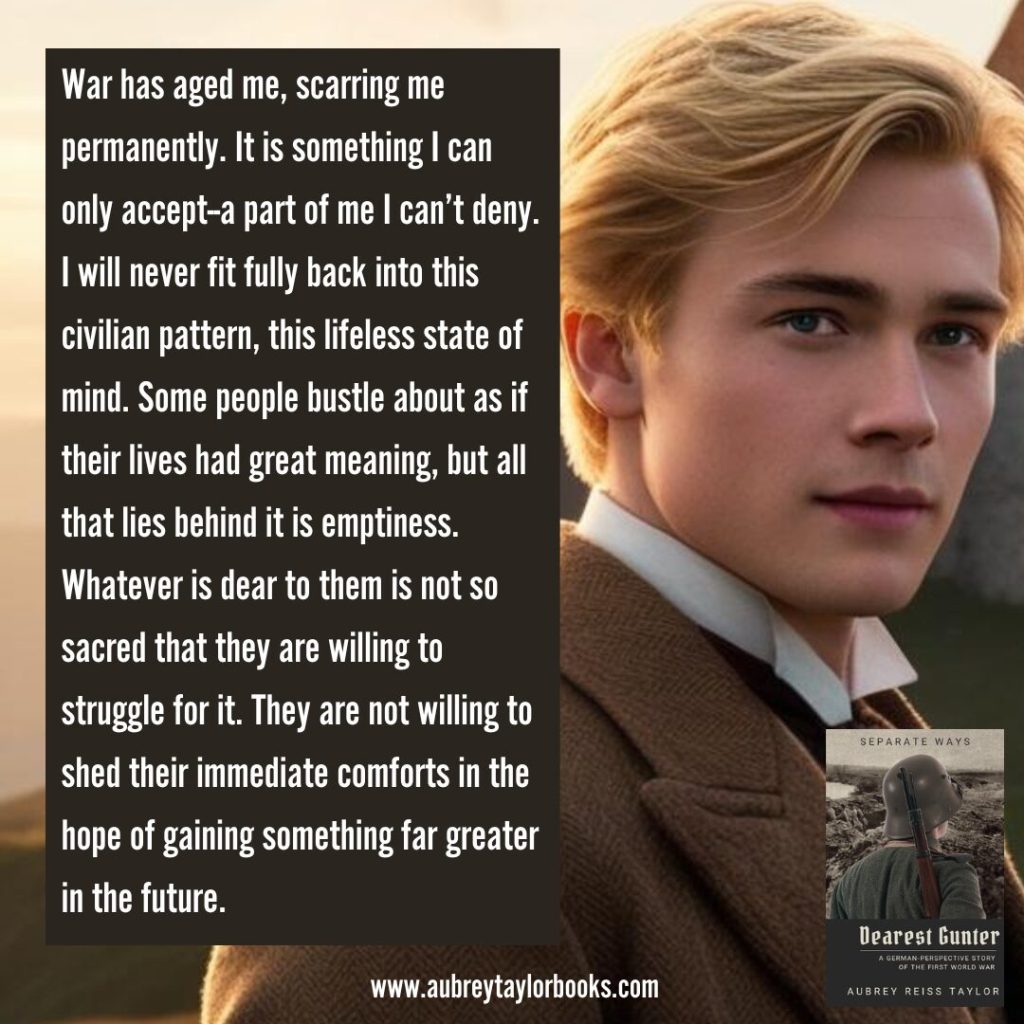
I don’t want to call this book a Historical Romance because while Gunter’s lovelife is a solid
theme throughout the book, this is not a love story. It is the story of a young man who fought in
and survived the First World War, and it is told from the German perspective.
I had great feedback from my editor and beta readers, and one of the recurring comments was
how horribly Gunter treated Lani and the other women in his life later in the story. I don’t
consider it a “spoiler alert” to warn readers that there is no “Happily Ever After” at the end of this
book. If you know my writing, you know what to expect. There may be an HEA, but it’s going to
be hard-fought and long in coming, and it certainly won’t look like the reader expects it to.
It may be three books later.
That having been said, I do owe it to Brave Authors fans to look a little more deeply into
Gunter’s treatment of the women in his life, because as with the history of the world wars, there
is more than one side to the story.
There can be no excuse for Gunter’s behavior. However, something unintended worked its way
into the middle of the book that deserves consideration.
Gunter is still young and sexually innocent when he returns to the front after his first
convalescent leave. He’s had a few wandering thoughts, some brief kisses, but he’s never
crossed the line, and he censures his brother’s promiscuous behavior.
It isn’t until his unit is pulled back from the trenches for a few days’ rest that he meets Suzette, a
French “farm girl” who up until that moment refuses to give the German soldiers billeted in her
house the time of day. Maybe it’s because they’re the enemy, or maybe it’s because of the
watchful older woman who runs the house. Either way, she sees something different in Gunter.
It emboldens her to make advances at him, offering him the attention she refused the other
soldiers.
One evening, with the rest of the men gone into town for whatever good times can still be found
that close to the front, Suzette sits alone with Gunter, watching him eat. Before long, she pulls
him into the kitchen and if it weren’t for the abrupt arrival of “Madame,” the reader can
extrapolate what would’ve happened.
Suzette is sneaky, though. She finds her way back to Gunter, and by that time, whether or not
he’s really attracted to her is irrelevant; he too is sick of holding out. Later in the book, he gives
us insight about how he was feeling at that time: “My innocence died in the mud back in
Cambrai.” The war had stolen his innocence. Everything else became fair game.
It is well-known that with their husbands gone to war, women were tempted to have affairs. A
similar struggle existed for teenage girls without their fathers at home. Lack of a father’s
presence created more opportunity, and often more desire to engage in trysts and romantic
interludes.
Sometimes, the void cannot be helped; it is our human nature that wants to fill that void
with the wrong things. I see this in my own life. Even though I was not promiscuous, I had a
lot of difficulty with “crushes” growing up. My parents separated when I was 7 or 8, and even
though I saw my dad, he wasn’t an integral part of my life.
Throughout my teens, severe heartbreaks piled up, one on top of another. Each time, it hurt a
little more. I was more willing to do whatever it took to find someone who would fill that void, but
God stepped in in a huge way, and I thank Him for the iron-clad protection with which He
preserved my purity.
In my writing, I tend to take a deeper interest in the man’s side of the story. My editor got
so frustrated with Gunter by the end of the book that she wanted to throttle him. Admittedly, it
becomes harder and harder to make sense of him, and that is by design. My hope all along
was that I could give readers an accurate depiction of the story of many (but certainly not
all) of the young German men who fought in the First World War.
One of my beta readers supposed that Gunter was unique in putting country ahead of family. In
most generations and in most places, I think that is an accurate assessment of the general
attitude, however, it was not unique to the German men of that generation. Many struggled
mightily to fit back into society, preferring to remain with their comrades-in-arms, who
understood them.
Consider some factors: the devastation of their male population, a lost war, political turmoil
within their borders, and the perception of a “stab in the back.” There is also the issue of
Germans having been raised on a steady diet of Prussian militarism for many years.
While it was hard for soldiers of every nation to settle back into civilian life, and each one of
them probably felt that the civilian population could not relate to the conditions they had
experienced, the factors above compounded the German man’s felt need to continue the
fight. Conditions throughout postwar Europe, especially in the Fatherland and to the East,
provided him with many opportunities to do so.
I based a lot of Gunter’s story on my study of the German Freikorps, and he is representative of
many of the men involved. Gunter’s case is particularly sobering because of his youth. He lied
about his age when he joined up, and when he came home from the war in 1918, he was still
only seventeen years old. The conditions in Germany were deplorable and would get worse
over the next five years.
This is the crux of my writing. Yes, it is one man’s story, laid out alongside the stories of a few
young women, but in reality, it is the story of a generation. A story that is not often told but is
essential for historic understanding. This is why I write what I do.
The “bravest” idea in my writing is a willingness to discuss what happened in Germany
and provide balance to a narrative that is still far too one-sided. I want to urge readers (and
my fellow writers) to stop seeing what happened in Germany in black and white terms. That
means considering that there is another side to the story, and for me, that also means being
willing to settle deep into their understanding of things, and prayerfully and patiently interpreting
it through characters like Gunter Schrader.
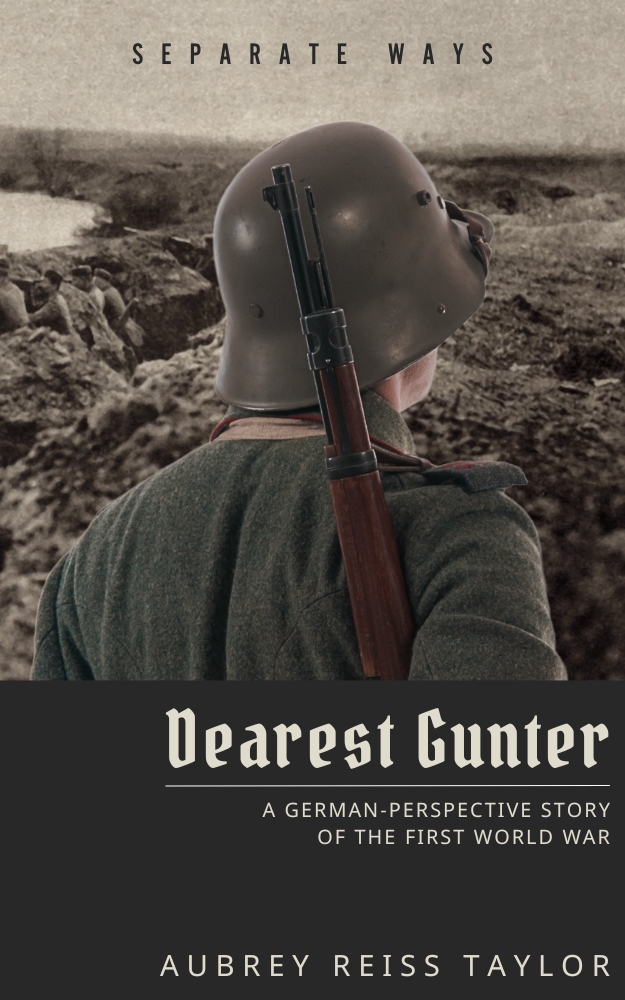
About the Book:
Gunter Schrader was left behind when his brothers went to war in 1914. Two and a half years
later, he makes his way to the front, though it means leaving the young woman he loves and
lying to his widowed mother.
The need to fight refuses to let him go, even after the guns fall silent in 1918. Reunited with his
brother Jochen and hungry to continue the struggle to secure Germany’s borders, it is only the
desire for a deeper connection that threatens Gunter’s plans.
Discharged and no longer bound to his oath as a soldier, he is faced with a choice:
Love for a woman, or love for his nation?
Buy it here: https://www.amazon.com/dp/B0DSCK425C

About the Author:
As a child, Aubrey spent countless hours creating characters and writing stories. Thirty years later, she took up her pen again, uniting her fascination for history with her passion for redemption. The stories she creates are a unique brand of gritty, honest wartime sagas written from the German perspective. She is a mother of three and married to her best friend, Brian. When she’s not writing or taking care of home and family, she can often be found making music, reading, or spending time with friends.
Website: www.aubreytaylorbooks.com
Newsletter: https://landing.mailerlite.com/webforms/landing/o3k4f2
Facebook: https://www.facebook.com/aubreytaylorbooks
Instagram: https://www.instagram.com/aubreytaylorbooks/
X: https://x.com/aubtaybooks